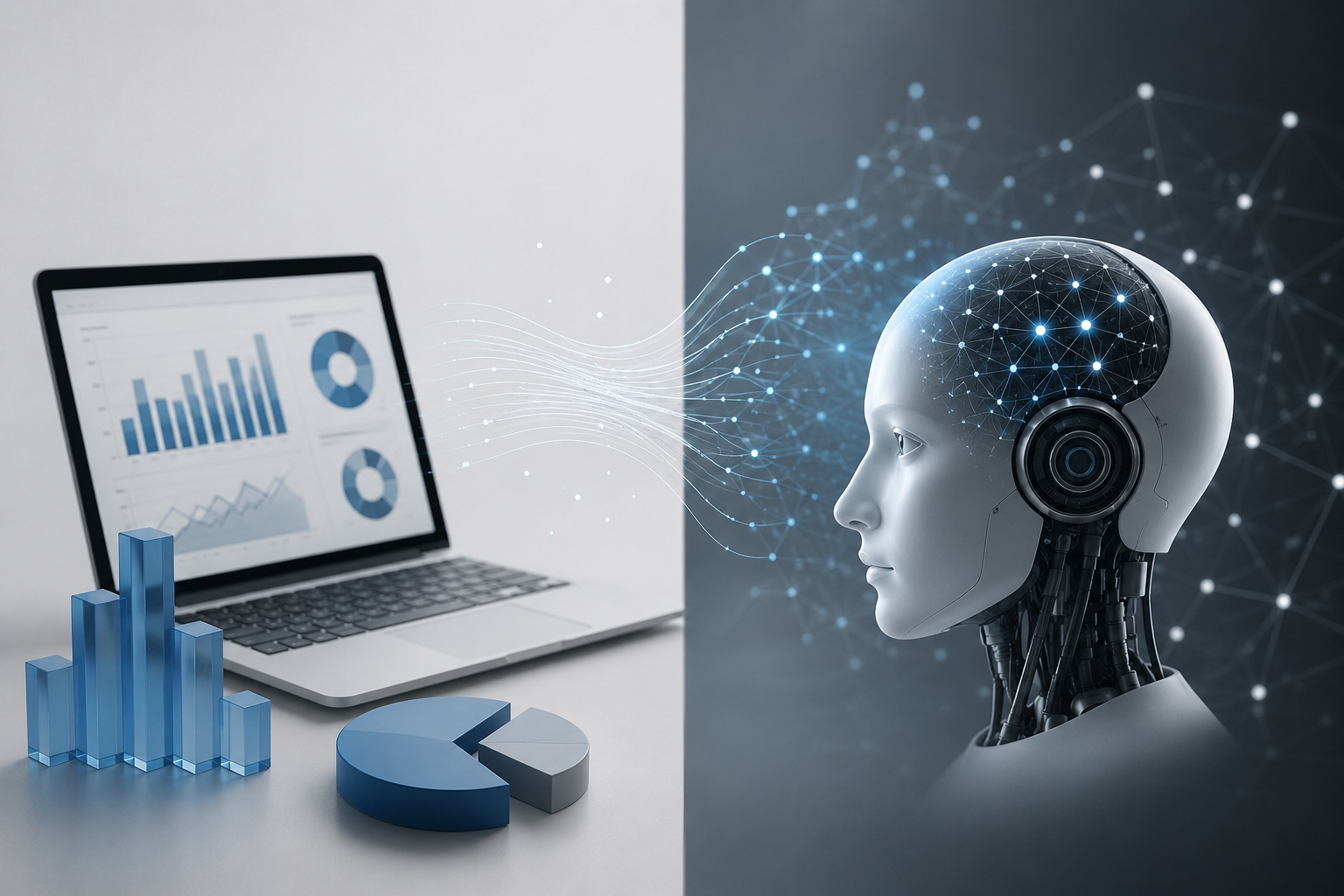
Data Science and Artificial Intelligence are two of the most discussed areas in technology today. They are often mentioned together because both work with data, algorithms and computing techniques. However, they are not the same field.
If you are planning to build a career in technology, understanding the difference between Data Science and AI can help you choose the right learning path. Data Science focuses heavily on collecting, analysing and interpreting data, while Artificial Intelligence focuses on creating systems that can perform tasks that normally require human intelligence.
The two fields also overlap. Data is often the foundation on which AI systems are trained, tested and improved. At the same time, data science uses several AI and machine learning techniques to discover patterns and make predictions.
So, what exactly separates Data Science from Artificial Intelligence?
What Is Data Science?
Data Science is the process of using data to find useful information, identify patterns and support better decisions. A data scientist may work with large and complex datasets collected from websites, applications, businesses, sensors or other digital systems.
The work usually involves several stages. Data needs to be collected, cleaned and organised before it can be analysed. Once the data is prepared, professionals can use statistical methods, programming and machine learning to identify trends and make predictions.
For example, an online business may analyse customer purchase data to understand which products are most popular. A company could also study customer behaviour to predict which users are more likely to make another purchase.
Common areas within Data Science include:
- Data collection and preparation
- Statistical analysis
- Data visualisation
- Exploratory data analysis
- Machine learning
- Predictive modelling
- Business analytics
- Data interpretation
Python, SQL, statistics, machine learning libraries and data visualisation tools are commonly associated with Data Science workflows.
What Is Artificial Intelligence?
Artificial Intelligence, commonly called AI, is a broader field focused on developing computer systems that can perform tasks associated with human intelligence.
These tasks can include recognising patterns, understanding language, making predictions, solving problems and responding to new information.
Think about a voice assistant understanding a spoken request, a recommendation system suggesting a movie or an AI application generating an answer to a question. These are examples of systems designed to perform intelligent tasks.
AI includes several areas, such as:
- Machine learning
- Deep learning
- Natural language processing
- Computer vision
- Generative AI
- Robotics
- Intelligent automation
Machine learning is particularly important because it allows systems to learn patterns from data instead of relying entirely on manually written instructions.
Data Science vs Artificial Intelligence: The Main Difference
The simplest way to understand the difference is to look at the primary objective of each field.
Data Science is mainly concerned with extracting knowledge and insights from data.
Artificial Intelligence is mainly concerned with building systems that can perform intelligent tasks.
A data scientist might analyse thousands of customer records and identify why certain customers are leaving a service. An AI engineer might develop a model that predicts which customers are likely to leave and automatically responds to those predictions.
This is why the two areas often work together.
Data Science helps organisations understand their data, while AI can use data to build systems that predict, automate or respond to different situations.
How Data Science and AI Work Together
Data Science and AI should not always be viewed as completely separate career paths. In many real-world projects, they complement each other.
Imagine a company wants to develop an intelligent recommendation system.
First, large amounts of customer and product data need to be collected and prepared. Data professionals may then analyse the information to identify customer behaviour and useful patterns.
Machine learning techniques can subsequently be used to train a recommendation model. The AI system can then use what it has learned to recommend products to customers.
This process shows how Data Science and AI can connect within the same project.
Skills Needed for Data Science
A career in Data Science usually requires a combination of technical, analytical and problem-solving skills.
Programming
Python is widely used for data analysis and machine learning. Understanding programming fundamentals makes it easier to work with datasets and develop analytical solutions.
Statistics
Statistics helps professionals understand patterns, relationships and uncertainty within datasets. Concepts such as averages, distributions, correlation and probability are useful foundations.
SQL and Databases
Data is often stored in databases, so knowing how to retrieve and work with information using SQL is an important practical skill.
Data Visualisation
Charts and dashboards can make complex datasets easier to understand. Data professionals need to communicate findings clearly rather than simply producing numbers.
Machine Learning
Machine learning helps professionals build models that can identify patterns and make predictions from data.
Analytical Thinking
Technical knowledge alone is not enough. Data professionals also need to understand the problem they are trying to solve and interpret results carefully.
Skills Needed for Artificial Intelligence
AI careers can require many of the same foundations as Data Science, but the focus can become more specialised.
Important areas include:
- Python programming
- Machine learning
- Deep learning
- Mathematics and statistics
- Neural networks
- Natural language processing
- Computer vision
- Model training and evaluation
- Data preparation
- AI frameworks and development tools
The exact skills required depend on the role. Someone working in machine learning may have a different skill set from someone specialising in computer vision or generative AI.
Career Opportunities in Data Science
Data Science can lead to several different career paths. Some professionals focus on analysing business data, while others work more deeply with machine learning and predictive models.
Possible roles include:
- Data Analyst
- Data Scientist
- Business Intelligence Analyst
- Machine Learning Analyst
- Machine Learning Engineer
- Data Engineer
- Business Data Consultant
The responsibilities can vary considerably between organisations, so it is useful to understand the role requirements before choosing a specialisation.
Career Opportunities in Artificial Intelligence
AI also offers several career directions as organisations increasingly explore intelligent software and automation.
Possible roles include:
- AI Engineer
- Machine Learning Engineer
- AI Developer
- Deep Learning Engineer
- NLP Engineer
- Computer Vision Engineer
- Robotics Engineer
Some of these positions require advanced knowledge of mathematics, programming and machine learning. Building a strong foundation before moving into specialised AI topics can make the learning process easier.
Learn Data Science and AI at SkillHaara
SkillHaara offers a Data Science, AI & Analytics academic pathway that combines analytics, machine learning and AI projects with practical learning. Its academic approach focuses on foundational knowledge, industry-relevant tools and hands-on projects.
For learners looking for a Career-oriented data science certification in Trivandrum, Aluva and Thrissur, SkillHaara provides structured learning options with practical training, project experience and career support.
The programs are designed for different types of learners, including students, graduates and working professionals who want to develop technical skills or explore a new career direction.