Skirts are among the most versatile garments in fashion design. They come in different lengths, shapes, fits and styles, making them suitable for casual wear, office outfits, festive occasions and formal events. From a simple straight skirt to a voluminous circular skirt, each design has its own construction requirements and pattern drafting techniques.
For fashion designers, understanding how different skirt patterns are developed is an important practical skill. A well-drafted pattern helps achieve the desired shape, comfortable fit and proper fabric distribution. It also reduces fabric wastage and makes garment construction easier.
In this guide, we will explore popular skirt styles, their basic features and the pattern drafting methods used to create them.
1. Understanding the Basics of Skirt Pattern Drafting
Pattern drafting is the process of creating a garment template using body measurements. This template is used to cut fabric pieces before stitching the final garment.
Before drafting a skirt pattern, a designer needs to understand the relationship between body measurements, garment shape and fabric behaviour.
The basic measurements required for most skirt patterns include:
- Waist measurement: The measurement around the natural waistline.
- Hip measurement: The measurement around the fullest part of the hips.
- Waist-to-hip depth: The vertical distance between the waistline and hip line.
- Skirt length: The distance from the waistline to the desired hemline.
- Hem circumference: The total width required at the bottom of the skirt.
The amount of wearing ease also needs to be considered. Ease provides additional room for movement and comfort. Its amount depends on the skirt style, fabric and intended fit.
A basic skirt block is often used as the starting point for developing several other skirt designs.
2. Different Types of Skirts and Their Pattern Drafting Methods
Each skirt style has a distinct silhouette. Some follow the natural shape of the body, while others create volume through gathers, pleats or fabric flare.
Here are some commonly used skirt designs and how their patterns are developed.
A. Straight Skirt
A straight skirt is a simple design that follows the body’s shape from the waist towards the hem. It usually has a similar width around the hip and lower portion, although slight shaping may be required for a comfortable fit.
Pattern drafting method:
- Begin with a basic skirt block using the waist and hip measurements.
- Mark the waistline, hip line and desired skirt length.
- Develop separate front and back pattern pieces.
- Add the required waist darts to remove excess fabric and shape the waist.
- Keep the side seams relatively straight from the hip towards the hem.
- Check the fit and add seam allowance before cutting the fabric.
Straight skirts are commonly used for everyday clothing, uniforms and simple formal outfits.
B. A-Line Skirt
An A-line skirt is fitted around the waist and gradually widens towards the hem. Its silhouette resembles the letter A, making it a popular choice for different types of outfits.
Pattern drafting method:
- Start with a basic skirt block.
- Mark the required amount of flare at the hemline.
- Draw lines from the hem towards the waist or dart area.
- Cut along the marked lines and spread the pattern sections to create additional width.
- Smooth the hemline and side seams.
- Adjust the waistline and darts to maintain a proper fit.
The amount of flare can be increased or reduced depending on the desired design.
C. Pencil Skirt
A pencil skirt is a fitted style that follows the natural body shape and becomes narrower towards the hem. It is commonly used for office wear and formal clothing.
Pattern drafting method:
- Draft a basic skirt block using accurate waist and hip measurements.
- Mark the desired skirt length.
- Gradually reduce the width at the hem on both front and back pattern pieces.
- Shape the side seams smoothly.
- Check the hip and thigh measurements to avoid excessive tightness.
- Include a suitable back slit or other movement allowance if needed.
Because this skirt has a narrow shape, proper fitting and walking comfort should be considered during drafting.
D. Circular Skirt
A circular skirt is known for its flowing shape and wide hemline. It is created by drafting a circular pattern with a smaller opening for the waist.
Depending on the amount of fabric used, it can be a full-circle or half-circle skirt.
Pattern drafting method:
- Take the waist measurement and decide whether the design will be a full or half circle.
- Calculate the waist radius according to the selected style.
- For a full-circle skirt, use the formula: Waist circumference ÷ 6.28.
- For a half-circle skirt, use the formula: Waist circumference ÷ 3.14.
- From the calculated radius, measure the desired skirt length.
- Mark the outer curve and cut the pattern.
- Add the required seam and hem allowances.
Circular skirts are suitable for dresses, festive outfits and designs that require a flowing appearance.
E. Half-Circle Skirt
A half-circle skirt creates a softer and less voluminous flare than a full-circle skirt. It is a useful option when a designer wants movement without using too much fabric.
Pattern drafting method:
- Calculate the waist radius by dividing the waist measurement by 3.14.
- Fold the fabric according to the required pattern layout.
- Mark the waist curve using the calculated radius.
- Measure the desired skirt length from the waist curve.
- Draw the outer hemline.
- Add seam allowance and hem allowance before cutting.
This style works well with lightweight and medium-weight fabrics.
F. Gathered Skirt
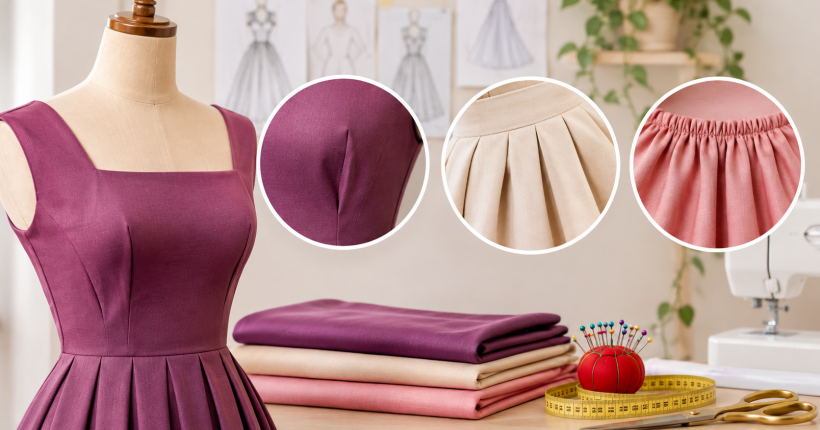
A gathered skirt contains extra fabric at the waist, which is pulled together using gathering stitches. This creates small folds and gives the skirt a fuller appearance.
Pattern drafting method:
- Measure the required finished waist circumference.
- Decide the gathering ratio based on the desired fullness.
- Multiply the finished waist measurement by the chosen ratio to calculate the fabric width.
- Mark the skirt length on the fabric.
- Cut the required rectangular fabric pieces.
- Stitch gathering lines along the top edge.
- Pull the threads evenly until the gathered edge matches the waistband measurement.
The gathering ratio depends on the fabric thickness and desired appearance. Lightweight fabrics can generally accommodate more gathers than bulky materials.
G. Pleated Skirt
Pleated skirts are designed using folds that are arranged systematically across the garment. Common variations include box pleats, knife pleats and inverted pleats.
Pattern drafting method:
- Measure the waist and decide the number and width of pleats.
- Calculate the total fabric required, including the fabric hidden inside the folds.
- Mark the pleat positions and fold depths on the pattern.
- Transfer the markings accurately to the fabric.
- Fold and press the pleats according to the selected design.
- Secure the upper portion with stitching before attaching the waistband.
Accurate marking is important because uneven pleats can affect the overall appearance and waist fitting.
H. Wrap Skirt
A wrap skirt is constructed using overlapping fabric panels that wrap around the waist. It is usually secured with ties, buttons or other fastening methods.
Pattern drafting method:
- Start with the required waist and hip measurements.
- Draft the main skirt panel based on the desired length and silhouette.
- Add extra width for the front overlap.
- Shape the waist and side seams according to the design.
- Draft the waistband or waist ties separately.
- Mark the fastening positions and check the overlap before cutting.
The overlap should provide sufficient coverage when the wearer moves or sits.
I. Panelled Skirt
A panelled skirt is made by joining multiple fabric sections vertically. It can have a fitted waist with a slightly flared or wider hem.
Pattern drafting method:
- Decide how many panels are required.
- Divide the basic skirt pattern into the selected number of sections.
- Mark the cutting lines from the waist towards the hem.
- Add flare to the lower portion if the design requires it.
- Separate the pattern pieces and add seam allowances.
- Join the panels carefully during garment construction.
Panelled skirts are useful for creating structured designs and distributing flare evenly.
J. Godet Skirt
A godet skirt features additional triangular or curved fabric inserts placed between the skirt panels. These inserts create extra movement and volume near the hem.
Pattern drafting method:
- Draft the main skirt pattern in the required shape.
- Decide where the godet inserts will be positioned.
- Mark the insertion points on the pattern, usually starting below the hip or thigh area.
- Create openings at the marked positions.
- Draft separate godet pieces with the required width and length.
- Insert the godets into the openings during stitching.
The number and size of godets determine how much flare the finished skirt will have.
3. How to Choose the Right Fabric for Different Skirt Styles
Fabric selection plays an important role in skirt design. Even when the pattern is drafted correctly, the final appearance can change depending on the fabric’s weight, texture, flexibility and drape.
Here are a few examples:
- Cotton: Suitable for A-line, gathered and everyday skirts because it is easy to handle and available in different weights.
- Silk: Works well for flowing and occasion-wear skirts due to its soft drape.
- Georgette: Suitable for layered, gathered and lightweight circular skirts.
- Denim: Commonly used for straight, pencil and panelled skirts that require more structure.
- Satin: Often selected for formal skirts because of its smooth surface and flowing appearance.
- Linen: Suitable for relaxed skirt designs, especially A-line and straight silhouettes.
Designers should also consider fabric grainline, shrinkage and stretch before cutting. These factors can affect the fit and final shape of the garment.
4. Common Mistakes to Avoid When Drafting Skirt Patterns
Pattern drafting requires accuracy and attention to detail. Even small measurement errors can affect the finished garment.
Some common mistakes include:
Using incorrect body measurements: Inaccurate waist or hip measurements can result in a skirt that is too tight or too loose.
Ignoring wearing ease: A pattern should allow comfortable movement, especially around the hips and thighs.
Incorrect dart placement: Darts help shape the waist. Incorrect placement can create unwanted folds or fitting problems.
Forgetting seam allowance: Seam allowance must be included before cutting fabric unless the pattern already accounts for it.
Ignoring fabric grainline: Incorrect grain placement can cause the skirt to hang unevenly or twist during wear.
Uneven hemline: Some fabrics, particularly bias-cut and circular designs, may need to hang before the final hem is marked.
Choosing an unsuitable fabric: A stiff fabric may not create the desired drape for a flowing skirt, while a very soft fabric may not provide enough structure for a tailored design.
Checking the paper pattern and making a sample garment when necessary can help identify problems before using the final fabric.
5. Why Pattern Drafting Skills Matter in Fashion Design
Pattern drafting connects a designer’s creative ideas with actual garment construction. It helps designers understand how a flat piece of fabric can be shaped into a wearable garment.
Learning different drafting methods allows designers to:
- Develop new skirt styles from basic patterns.
- Adjust garment measurements for individual customers.
- Create different silhouettes using the same basic skirt block.
- Reduce unnecessary fabric wastage.
- Improve garment fitting and finishing.
- Develop custom clothing designs for different occasions.
These skills are useful for aspiring fashion designers, tailoring professionals and individuals interested in developing their own clothing collections.
6. Learn Practical Fashion Design Skills with Skill Haara
Understanding garment patterns is an important part of becoming a fashion designer. Along with creativity, designers need practical knowledge of measurements, fabric selection, pattern development and garment construction.
Skill Haara provides fashion design training for individuals interested in learning the practical aspects of fashion design. Developing an understanding of different garment styles and pattern drafting methods can help learners build a foundation for creating their own clothing designs.
For anyone interested in exploring fashion as a skill or future career, learning how to draft and construct different garments is a useful starting point.
Conclusion
Skirt design involves much more than choosing a particular shape or fabric. Each style requires a suitable pattern drafting method to achieve the intended fit, volume and silhouette. Straight, A-line, pencil, circular, gathered, pleated, wrap and panelled skirts all demonstrate how a basic pattern can be modified to create different designs.
By understanding body measurements, fabric properties and drafting techniques, aspiring designers can develop the skills needed to turn their ideas into finished garments. Practising these methods with different fabrics and patterns is one of the best ways to improve garment construction skills and build confidence in fashion design.