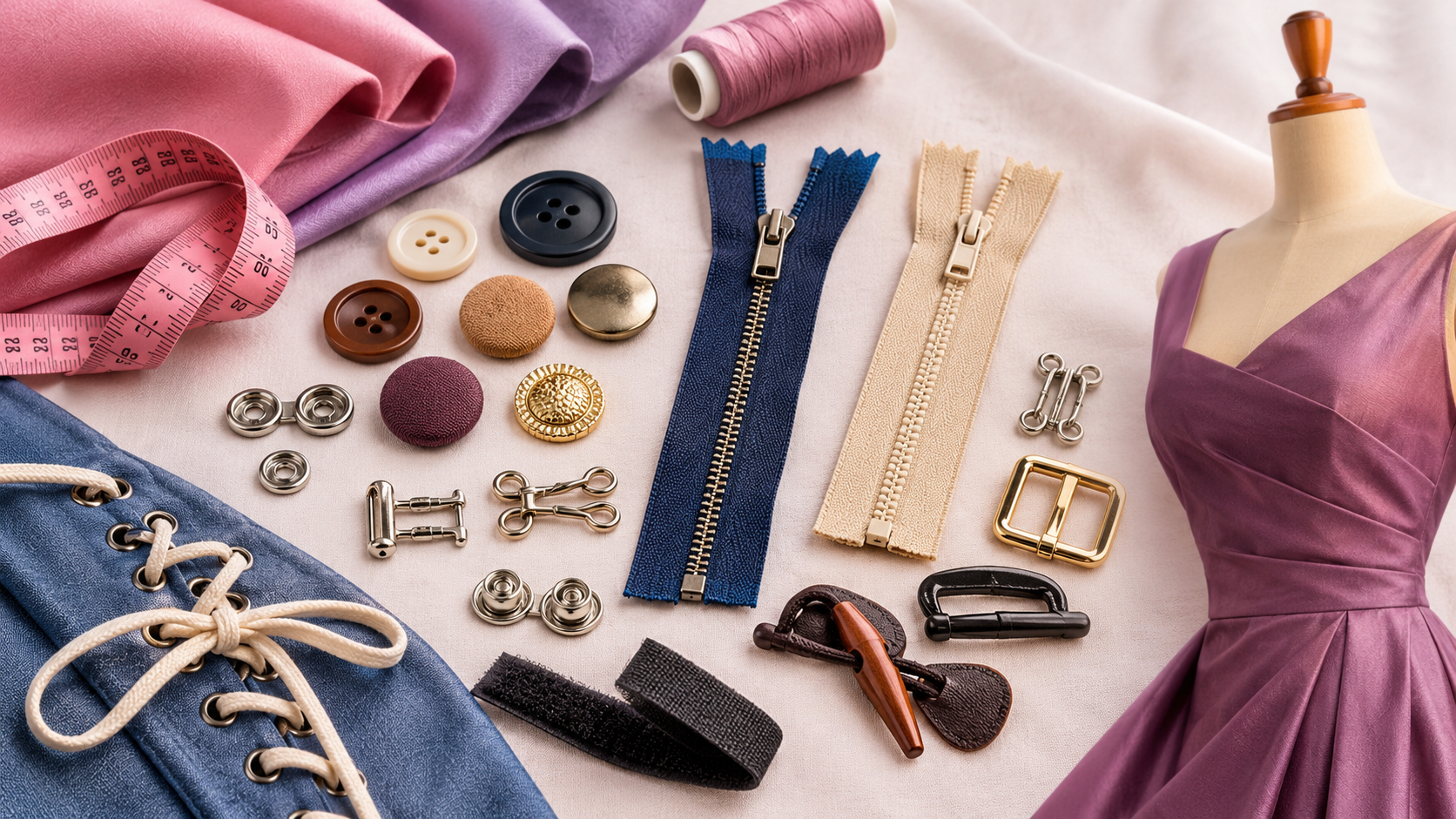
Garment fasteners are small components that play an important role in clothing design and construction. They help hold different sections of a garment together, make dressing easier and contribute to the overall appearance of an outfit. From buttons on everyday shirts to concealed zippers on formal dresses, each fastener has a specific purpose.
Choosing the right fastener involves more than deciding how a garment should open and close. Designers need to consider the fabric, garment structure, comfort, durability and overall style. A heavy metal fastening may not be suitable for delicate fabric, while a decorative closure might not provide enough support for a fitted garment.
Understanding the different types of garment fasteners helps aspiring designers make better construction decisions. Here is a closer look at commonly used fasteners, their features and where they are most suitable.
What Are Garment Fasteners?
Garment fasteners are components used to join two sections of clothing temporarily or securely. They allow the wearer to open and close a garment without damaging the fabric or affecting its structure.
They are commonly placed along openings such as shirt fronts, waistbands, necklines, cuffs, sleeves and dress backs. Some remain visible and become part of the garment’s design, while others are concealed to create a clean finish.
The choice of fastener depends on the purpose of the clothing. A jacket, for example, needs a closure that can withstand regular movement, whereas a lightweight blouse may require a smaller and less noticeable option.
1. Buttons
Buttons are among the most commonly used garment fasteners. They come in different shapes, sizes, materials and finishes. A button generally works with a buttonhole or loop, allowing two sections of fabric to stay together.
Buttons can be made from plastic, metal, wood, shell and fabric-covered materials.
Common types of buttons include:
- Flat buttons: These have holes through the centre and are widely used on shirts, trousers, skirts and everyday clothing.
- Shank buttons: These have a small loop at the back instead of holes through the front. They provide space between the button and the fabric.
- Snap buttons: These consist of matching parts that press together and are commonly used in children’s clothing, jackets and casual garments.
- Decorative buttons: These are selected for their appearance and can add visual detail to coats, dresses and traditional outfits.
Buttons are versatile because they are easy to replace and available in many designs. Their size and weight should match the garment fabric to prevent pulling or distortion.
2. Zippers
Zippers are fastening components made of two rows of interlocking teeth or elements connected by a sliding mechanism. Moving the slider joins or separates the two sides. They are commonly used in dresses, skirts, trousers, jackets and accessories.
Some commonly used zipper types include:
- Concealed zippers: These are designed to remain hidden within a seam. They are often used in dresses and skirts where a neat finish is preferred.
- Exposed zippers: These remain visible on the outside and can become a decorative feature.
- Metal zippers: These have metal teeth and are frequently used in denim, leather jackets and heavier garments.
- Plastic moulded zippers: These have individual plastic teeth and are suitable for jackets, bags and casual clothing.
- Coil zippers: These use continuous coil-shaped elements and are commonly found in lightweight garments and accessories.
- Separating zippers: These can be completely separated into two parts, making them suitable for jackets and outerwear.
When choosing a zipper, designers should check its length, strength, flexibility and compatibility with the fabric. Correct installation is equally important because uneven stitching can cause puckering and affect the garment’s appearance.
3. Hooks and Eyes
Hooks and eyes are small fastening components used when a discreet closure is needed. The hook catches onto a small metal loop or eye to hold the garment together.
They are commonly found on blouses, skirts, waistbands, bras and formal garments. In some designs, they provide additional support alongside a zipper or another fastening system.
Hooks and eyes are available in different sizes and finishes. Smaller versions work well with delicate clothing, while stronger options are suitable for areas that experience more tension.
Their compact size makes them useful for garments where visible closures are not required. Correct alignment is important to ensure that the fastening stays secure during wear.
4. Press Studs or Snap Fasteners
Press studs, also called snap fasteners, consist of two matching components that lock together when pressed. They can be opened by pulling the two sides apart.
They are useful when designers want a quick closure without creating traditional buttonholes. Common applications include baby clothing, shirts, jackets, uniforms and casual garments.
Press studs are available in metal and plastic. Some are stitched onto the fabric, while others are attached using a setting tool.
Since repeated pulling can weaken the surrounding material, their placement needs attention. Lightweight fabrics may require reinforcement to prevent tearing or distortion.
5. Velcro or Hook-and-Loop Fasteners
Hook-and-loop fasteners consist of two fabric strips. One side contains tiny hooks, while the other has soft loops. When pressed together, the surfaces attach and can be separated by pulling them apart.
These fasteners are useful for clothing that needs quick and adjustable closures.
They are commonly used in children’s clothing, sportswear, adaptive clothing, jackets, adjustable cuffs and certain accessories.
One advantage is that they are easy to operate without using buttons or zippers. They can also be adjusted according to the wearer’s needs. Their main limitation is that the strips may collect lint, and the rough hook surface can catch on delicate fabrics.
6. Ties and Fabric Loops
Ties and fabric loops are fastening options made from fabric strips, cords or attached loops. They are often used when the closure is intended to become part of the garment’s design.
They can be seen in wrap dresses, blouses, waistbands, traditional clothing and decorative necklines.
Fabric ties allow the wearer to adjust the tightness and fit. They can also create soft folds and gathered details. Designers may use the same fabric as the garment or choose a contrasting material for a more noticeable finish.
The length, width and placement of the ties should be planned carefully. They need to remain secure without becoming difficult to handle.
7. Toggles and Toggle Fasteners
Toggle fasteners use an elongated component, often made from wood, plastic or metal, that passes through a loop to secure the garment. They are commonly associated with coats, jackets and outerwear.
Unlike ordinary buttons, toggles are usually visible and can become a distinctive design feature. They are particularly useful in casual and winter clothing.
The loop must be strong enough to hold the toggle securely. When used on thick garments, designers should consider the weight of the fastening and reinforce its attachment area where necessary.
8. Buckles
Buckles are fastening components that secure fabric straps by passing them through a frame or locking mechanism. They are commonly used in belts, waistbands and adjustable garment straps.
They can be functional or decorative, depending on the design. Buckles are available in metal, plastic and other materials.
Their size and weight should suit the garment. A large metal buckle may work well with a structured belt but could feel uncomfortable on a lightweight dress. Designers should also check that the buckle does not restrict movement.
9. Eyelets and Grommets
Eyelets and grommets are small reinforced openings placed in fabric. They allow cords, laces or ribbons to pass through without easily damaging the material.
They are commonly used in corset-style garments, hoodies, sportswear, footwear and decorative clothing.
Eyelets are generally smaller and lighter, while grommets are often stronger and may include a washer for reinforcement. The surrounding fabric may need additional support before installation.
These components can serve both functional and decorative purposes. For example, metal eyelets arranged along the front of a garment can create a lace-up design.
10. Lacing
Lacing uses a cord, ribbon or lace threaded through a series of holes, loops or eyelets. The wearer can tighten or loosen the garment by adjusting the lace.
This fastening method is commonly seen in corset-inspired dresses, bodices, footwear and certain traditional garments.
Lacing is useful when adjustable fitting is required. It can also become a noticeable design element, especially when contrasting cords or decorative ribbons are used.
The spacing of the eyelets should be consistent to maintain an even appearance. Designers must also ensure that the garment can handle the tension created when the lace is tightened.
How to Choose the Right Fastener for a Garment
Not every fastener works well with every clothing design. The right choice should support the garment’s construction while making it comfortable and easy to wear.
1. Consider the fabric: Lightweight materials such as chiffon and georgette may require delicate hooks, small buttons or concealed zippers. Denim and heavier cotton fabrics can support stronger buttons and metal zippers.
2. Match the garment design: A formal dress may need a concealed zipper, while a casual jacket could use exposed zippers or toggles. Decide whether the closure should remain hidden or become part of the design.
3. Check comfort and ease of use: A fastener should be simple to operate and should not cause discomfort. Its position should allow the wearer to open and close the garment without unnecessary effort.
4. Think about durability: Everyday clothing needs fasteners that can withstand repeated opening, closing and movement. Both the fastening component and its attachment to the fabric affect durability.
5. Plan the placement: Incorrect positioning can affect the garment’s fit and appearance. Buttons, zippers and hooks should be planned during the pattern-making and construction stages rather than added as last-minute details.
Common Mistakes to Avoid When Using Garment Fasteners
Even a well-designed garment can look unfinished when its fasteners are poorly selected or attached. Some common mistakes include:
- Choosing heavy fasteners for delicate fabrics without reinforcement.
- Using a zipper that is too short or too long for the opening.
- Placing buttons too far apart, causing the garment to gape.
- Attaching hooks and eyes without checking their alignment.
- Selecting decorative closures that interfere with comfort.
- Ignoring the colour and finish of visible fastening components.
- Failing to reinforce areas that experience repeated pulling.
Testing the fastening system before completing the garment can help identify these issues early. Designers should open and close it several times to check its movement, strength and placement.
Why Learning About Garment Fasteners Matters in Fashion Design
Understanding garment fasteners is an important part of practical fashion design training. Designers need to know how different closures work, where they should be placed and how they influence the finished garment.
This knowledge is useful during pattern making, garment construction and sample development. For example, someone designing a fitted dress needs to decide whether a concealed zipper or another fastening system will provide the right combination of support and appearance.
At Skill Haara, learners interested in developing fashion design skills can explore fashion design training and build a better understanding of garment-related concepts and techniques. Practical exposure to garment construction and design activities can help beginners understand how individual components come together in a finished outfit.
Final Thoughts
Garment fasteners may be small components, but they have a direct impact on clothing functionality, fit and finishing. Buttons, zippers, hooks, press studs, buckles, ties and lacing systems each serve different purposes.
The right choice depends on the fabric, garment structure, design requirements and comfort of the wearer. Learning how these fasteners work helps aspiring fashion designers make thoughtful construction decisions.
A well-finished garment is not only about its colour, silhouette or fabric. The smaller construction details matter too, and choosing the right fastener is an important part of getting those details right.